
International
COSPAS-SARSAT
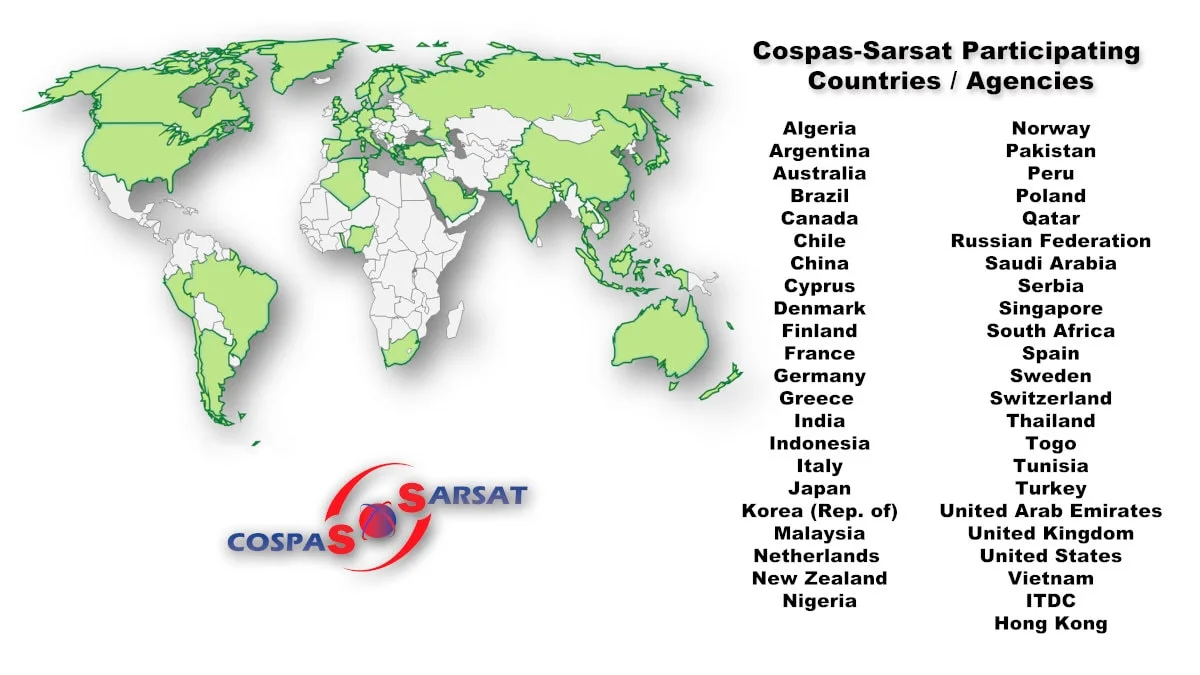
The International Cospas-Sarsat Program is a satellite-based search and rescue (SAR) distress alert detection and information distribution system, best known for detecting and locating emergency beacons activated by aircraft, ships and backcountry hikers in distress. The International Cospas-Sarsat Program began as a joint effort of Canada, France, the United States, and the former Soviet Union in 1979. It was formally constituted as an intergovernmental organization in 1988 through the International Cospas-Sarsat Program Agreement (the Agreement or ICSPA) signed by the four “Parties” to the Agreement: Canada, France, the USA and the former USSR. The Russian Federation replaced the USSR as Party to the Agreement in January 1992. Including the four Parties to the Agreement, 43 States and 2 organizations (the Participants) are now currently formally associated with the Program and actively participate in the management and the operation of the Cospas-Sarsat System (the System). COSPAS (КОСПАС) is an acronym for the Russian words "Cosmicheskaya Sistema Poiska Avariynyh Sudov" (Космическая Система Поиска Аварийных Судов), which translate to "Space System for the Search of Vessels in Distress".
Rescue Coordination Centers
Alaska Rescue Coordination Center
Alaska is a vast and rugged state, with a geography that poses significant challenges for search and rescue. With more miles of coastline than the other 49 states combined, and complex terrain, search and rescue operations in Alaska require careful planning, coordination, and execution. Because of its sheer size and varied geography, search and rescue operations in Alaska are carried out by several different agencies, including Alaska Air National Guard’s 176th Wing, the United States Coast Guard, the National Park Service, Alaska State Troopers, and the Civil Air Patrol. The success of search and rescue operations in Alaska depends on the close coordination and collaboration of these multiple agencies. Each agency brings its own unique skillset to the table, and together they work to ensure that individuals in distress receive the help they need as quickly and safely as possible. The Alaska Rescue Coordination Center (AKRCC) plays a critical role in coordinating search and rescue operations across the state.
Air Force Rescue Coordination Center 
As the United States' inland search and rescue coordinator, the Air Force Rescue Coordination Center serves as the single agency responsible for coordinating on-land federal SAR activities in the 48 contiguous United States, Mexico and Canada.
The AFRCC operates 24 hours a day, seven days a week. The center directly ties in to the Federal Aviation Administration's alerting system and the U.S. Mission Control Center. In addition to the Search and Rescue Satellite Aided Tracking information, the AFRCC computer system contains resource files that list federal and state organizations, which can conduct or assist in SAR efforts throughout North America.
U.S. Coast Guard Rescue Coordination Centers
Coast Guard RCCs coordinate maritime search and rescue responses within specific geographic areas. These areas are divided into 9 separate Districts:
| RCC | Location | Area of SAR Coordination Responsibility | Phone Number |
|---|---|---|---|
| Atlantic Area SAR Coordinator | Commander U.S. Coast Guard Atlantic Area Portsmouth, Virginia | Overall responsibility for areas covered by RCC Boston, RCC Norfolk, RCC Miami, RSC San Juan, RCC New Orleans and RCC Cleveland plus a portion of the North Atlantic Ocean out to 40 degrees west longitude. | (833) 453-1009 |
| RCC Boston | Commander Northeast Coast Guard District Boston, Massachusetts | New England down to and including a portion of Northern New Jersey plus U.S. waters of Lake Champlain. | (866) 842-1560 |
| RCC Norfolk | Commander East Coast Guard District Portsmouth, Virginia | Mid-Atlantic states including the majority of New Jersey down to the North Carolina / South Carolina Border. | (833) 453-1269 |
| RCC Miami | Commander Southeast Coast Guard District Miami, Florida | Southeast states from the South Carolina / North Carolina border around to the eastern end of the Florida panhandle plus a large portion of the Caribbean Sea. | (800) 874-7561 |
| RSC San Juan (Sub-Center of RCC Miami) | Commander Sector San Juan San Juan, Puerto Rico | Southeast portion of the Caribbean Sea | (833) 453-1267 |
| RCC New Orleans | Commander Heartland Coast Guard District New Orleans, Louisiana | Southern states including the Florida panhandle to the U.S. / Mexico border in Texas plus the inland rivers including the Mississippi, Missouri, Ohio and tributaries. | (855) 485-3727 |
| RCC Cleveland | Commander Great Lakes Coast Guard District Cleveland, Ohio | U.S. waters of the Great Lakes, their connecting rivers and tributaries. | (800) 321-4400 |
| Pacific SAR Coordinator | Commander U.S. Coast Guard Pacific Area Alameda, California | Overall responsibility for areas covered by RCC Alameda, RCC Seattle, RCC Honolulu and RCC Juneau. | (800) 246-7236 |
| RCC Alameda | Commander Southwest Coast Guard District Alameda, California | California and Eastern Pacific Ocean waters assigned by international convention off the Coast of Mexico. | (800) 246-7236 |
| RCC Seattle | Commander Northwest Coast Guard District Seattle, Washington | Oregon and Washington | (866) 498-0713 |
| RCC Honolulu | Commander Oceania Coast Guard District Honolulu, Hawaii | Land and waters of Hawaii, U.S. Pacific Islands and waters of Central Pacific Ocean assigned by international convention (extending from as far as 6 degrees south to 40 degrees north latitude and as far as 110 west to 130 east longitude). | (800) 331-6176 |
| RSC Guam (Sub-Center of RCC Honolulu) | Forces Micronesia / Sector Guam | Guam and other U.S. territories and possessions in the far western Pacific Ocean. | (877) 418-0168 |
| RCC Juneau | Commander Arctic Coast Guard District Juneau, Alaska | Alaska, U.S. waters in North Pacific Ocean, Bering Sea, and Arctic Ocean | (800) 478-5555 |